
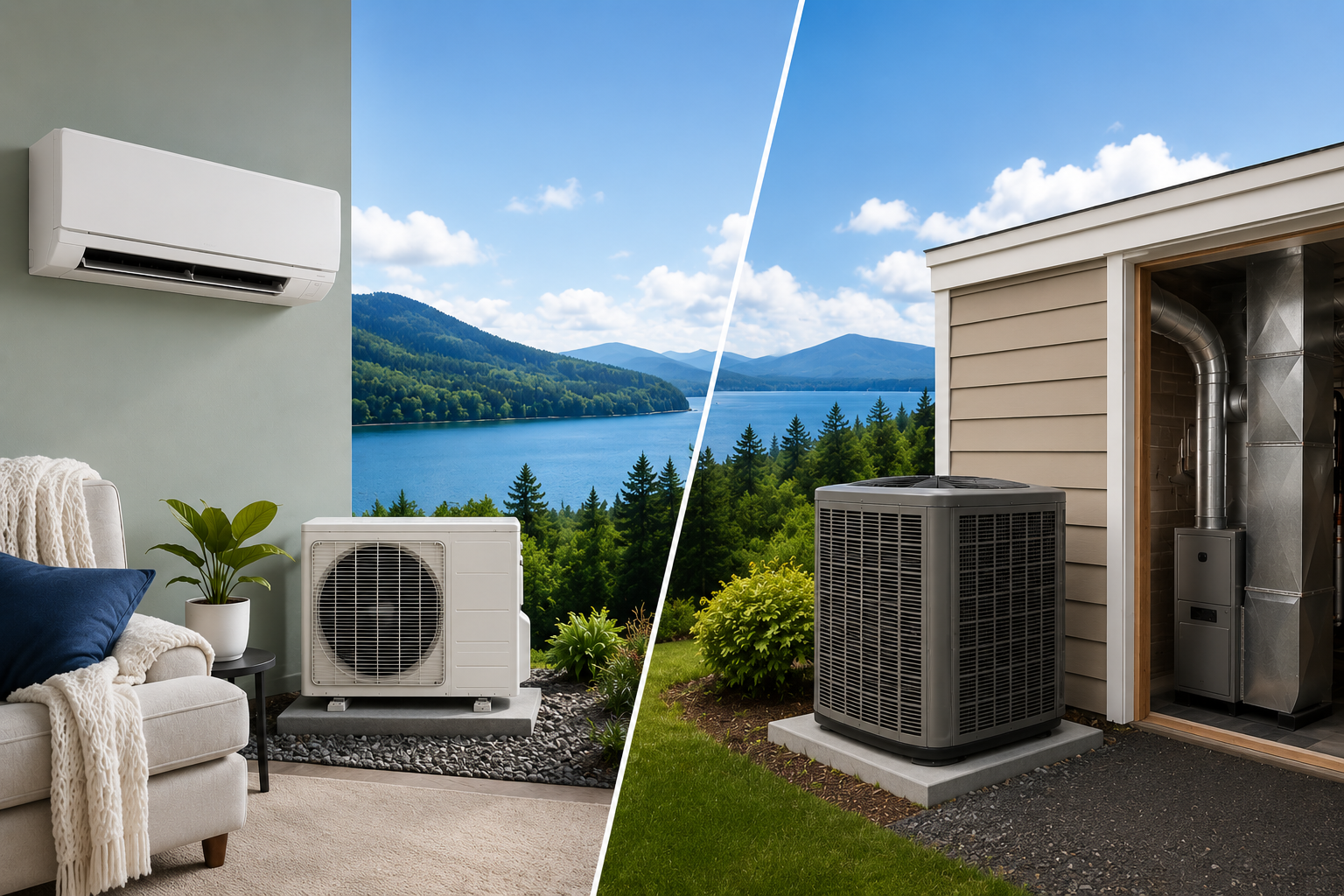
When you think about cooling your home in New Hampshire it may not seem like a necessity.
However, our weather can change dramatically throughout the year, and hot, humid summers can make staying comfortable a challenge. If you’re considering adding air conditioning, you’ll typically be looking at two main options: mini splits or central air. Both are common solutions, but they operate very differently. Some systems may also qualify for New Hampshire energy rebates.
In this guide, we’ll break down mini splits vs. central air in NH, from how each system works to the pros and cons of both. While online research is a great place to start, every home is different and has its own unique layout and heating and cooling needs. During your in-home walkthrough, we evaluate those factors and recommend a solution that’s tailored to your home, budget, and comfort goals.
👉 Need help deciding? Contact our team for a personalized recommendation.
Mini Split Systems in New Hampshire Homes
A mini split is a ductless cooling system with heating capabilities that delivers conditioned air directly into individual rooms or zones without requiring ductwork.
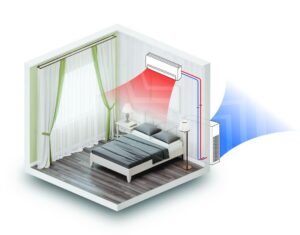 How Mini Splits Work
- Outdoor unit – transfers heat between your home and the outdoor air
- Indoor unit(s) – delivers heated or cooled air directly into each room or zone
- Refrigerant line sets – connects the indoor and outdoor units, carrying refrigerant and electrical communication between them
Pros of Mini Splits
Room-by-room control
Mini splits allow you to set the temperature for individual spaces, so you can focus on the areas you use most instead of wasting energy cooling unused spaces.
High efficiency
Mini splits are one of the most efficient AC options in New Hampshire because they don’t lose energy through ductwork. They adjust output based on demand, rather than cycling on and off, helping keep consistent temperatures and reduce energy usage.
Cold-climate heating capabilities
Depending on the system chosen, mini splits can serve as your primary heating source in Lakes Region homes. Significantly cutting down on gas or oil costs.
Installation matters
At Smith River HVAC, we install Mitsubishi Electric systems as a Diamond Elite Contractor. This means our team has been trained and vetted by Mitsubishi for proper system design, installation standards, and long-term performance in New Hampshire’s climate. It also provides us with extended warranty options. In climates like the Lakes Region, proper installation is just as important as the equipment itself.
Cons
Higher upfront cost
Depending on how many zones you need and system design, initial costs can be higher than a basic central air system.
Visible indoor units
Most systems use wall-mounted units that are visible in each room. Ceiling cassette options are available but typically increase cost.
Central Air Systems in New Hampshire Homes
Central air is a cooling system that uses your existing furnace and ductwork to distribute cool air throughout an entire floor or home. With one system you can cool an entire floor or home.
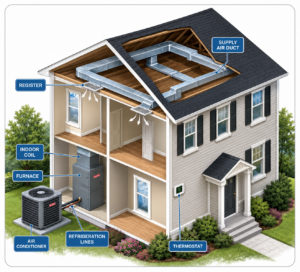 How Central Air Works
- Return ducts – Pulls the warm air from your home into the system
- Evaporator coil and outdoor condenser – The indoor evaporator coil works with the outdoor condenser to remove heat from the air using refrigerant
- Supply ducts and vents – The cooled air is distributed back through your home’s ductwork and into each room
Pros of Central Air
Clean, traditional appearance
Central air systems are mostly hidden, with only vents and thermostats visible. Both of which are typically already a part of a home that has forced air heating.
Lower upfront costs (with existing ductwork)
If your home already has properly sized and sealed ductwork, central air installs can be more cost-effective to install.
Simple whole-home cooling
Depending on your home layout, a single system can cool an entire floor, or the whole home. Making it straightforward and simple to use.
Cons of Central Air
Ductwork limitations
Homes without existing ductwork can require a costly and invasive installation. Older or poorly designed ductwork may need to be replaced to improve performance. Driving up the cost.
Energy loss through ducts
In many older New Hampshire homes, ductwork can leak or be poorly insulated, reducing efficiency.
Less flexibility
Central air operates on one thermostat, keeping the home at one temperature. Making it harder to address hot or cold spots without additional upgrades.
Higher operating costs in some homes
While initial installation can be more cost-effective than splits, homes with insulation challenges or larger homes can be less efficient when cooling the entire space compared to zoning options with mini splits.
Mini Split vs Central Air in NH: Which Is Right for Your Home?
Short answer: the right system depends on your home size/layout, existing infrastructure, and your comfort goals.
Mini Splits might be a better fit if:
- Your home is older with inefficient ductwork or no ductwork
- You only need cooling in certain areas
- You like the idea of having room-by-room control
- You have an open floor plan
Central Air might be a better fit if:
- Your home already has well-designed ductwork
- You want a simple, whole-home solution
- You want a more hidden and traditional appearance
- You have space available for ductwork (attic, basement, utility area)
FAQ: Mini Splits vs Central Air in New Hampshire
Are mini splits cheaper to run than central air?
In most cases, yes. Mini splits avoid duct losses and allow you to condition only the spaces you use. However, total cost depends on home layout and usage habits.
Do mini splits work in NH winters?
Yes, mini splits are increasingly popular in the Lakes Region and White Mountains as both heating and cooling systems. Modern splits are designed to work in northern climates where temperatures are frequently below freezing in the winter. Hyper-Heat systems are rated to operate in temperatures as low as -13°F.
Please note: Wind chill temperature is not a factor in operable temperatures.
How long do mini splits vs central AC last
Mini splits can last 15 – 20+ years with good maintenance. While central air typically has a life span of 12-15 years. With central air, you may only need to replace the equipment if the ductwork remains in good condition.
Is central air worth it in older homes?
This depends on your home’s existing infrastructure. Many older homes in New Hampshire have ductwork limitations that can reduce efficiency. Layout and insulation also plays a major role.
What are your next steps?
There’s no one-size-fits-all cooling solution when it comes to cooling your home in the Lakes Region. The right choice depends on your home layout, insulation, and how you want to use each space.
At Smith River HVAC we work directly with homeowners to design a system that fits their home, comfort goals, and budget.
If you’re considering adding AC to your home, give us a call or fill out our lead form to schedule a free estimate.